The future of robotics is increasingly tied to its ability to learn, adapt, and interact intelligently with the real world. The Teqie Trolley project is a foundational initiative focused on establishing a cutting-edge, AI-driven robotics platform – built for experimentation, development, and deployment in environments that demand precise perception, control, and autonomy.
Whether you're managing a product roadmap for smart devices, leading an IoT team, or engineering embedded systems, this initiative offers a real-world glimpse into a scalable, sensor-rich system architecture that bridges software intelligence with robust hardware.
Vision: A Learning, Perceiving, Acting Machine
The goal behind Teqie Trolley is to create a platform that goes beyond simple automation. It is designed to operate with contextual awareness and decision-making capabilities, powered by AI and sensor-rich architecture.
Example Tasks the Platform Can Perform:
- Line and edge tracking using infrared and vision-based systems;
- Obstacle detection and dynamic rerouting;
- Indoor localization and navigation via LiDAR and IMU fusion;
- Object recognition or person-following based on camera input and AI inference.
Data Ingestion and Processing Capabilities:
- 2D and 3D visual streams from HD and depth cameras;
- Time-of-flight measurements for depth awareness;
- Real-time ultrasonic and infrared proximity data;
- Orientation and acceleration data from a 9-axis IMU;
- LiDAR point clouds for spatial mapping.
These data sources are processed both on-board and at the edge, enabling real-time decision-making without reliance on cloud computation.
Hardware Architecture: Sensor-Rich, Modular, and Scalable
The Teqie Trolley integrates a wide variety of components through a layered architecture, separating motion control, perception, and system coordination:
.png?width=1540&height=1129&name=Softeq%20Building%20Teqie%20Trolley%20Graphic%20(880%20x%20645%20px).png)
Motor Control & Locomotion
Locomotion is handled by an embedded control platform built around the STM32F303ZE microcontroller, hosted on an ST NUCLEO-F303ZE board. This Cortex-M4 MCU provides deterministic control over motors and real-time feedback processing.
Key components include:
- L298N Motor Driver: Dual H-bridge controller driving two high-torque MG996R servo motors for differential steering;
- ICM-20948 IMU (9-axis): Enables orientation tracking and inertial dead reckoning. Especially valuable for wheel slippage compensation and balance estimation;
- TCRT5000 Infrared Sensor: Often used for line-following or edge detection, useful for structured environments like warehouses;
- HC-SR04 Ultrasonic Sensor: Provides distance measurements for basic obstacle detection, often used to initiate stops or detours;
This subsystem is optimized for low-latency motor control, leveraging PWM signals, encoder feedback (if added), and real-time safety cutoffs.
Computer Vision and Perception
The perception subsystem runs on a SPEAR-MX8 CPU board, a multicore Arm platform suitable for edge inference. It integrates several perception modalities:
- Logitech Full HD Camera: Captures video feeds used in visual navigation, object recognition, or gesture-based interaction;
- LD14P 360° LiDAR: Produces real-time point cloud data for mapping, obstacle avoidance, and SLAM (Simultaneous Localization and Mapping);
- Time-of-Flight (ToF) Camera (planned integration): Offers high-precision depth sensing ideal for dynamic environments and 3D space interaction;
This allows the platform to combine classical CV techniques with ML-based scene understanding, making it suitable for semi-structured and unstructured environments.
Expandable Input-Output Interface
The platform is built with extensibility in mind. Its I/O architecture supports:
- Additional digital/analog sensors (temperature, gas, touch);
- Actuator control (grippers, pan-tilt units);
- Communication interfaces (I²C, SPI, UART, CAN);
- GPIO pins for custom hardware integration,
This flexibility ensures the Teqie Trolley can evolve with specific domain requirements, from indoor delivery to interactive robotics.
Software Stack: Embedded Linux Meets Machine Learning
The software architecture blends open-source frameworks with custom tooling, enabling rapid development and integration:
- Operating System: Yocto Linux OS for reliable multitasking, real-time extensions, and compatibility with modern frameworks;
- Machine Learning Framework: TensorFlow is used for model deployment, supporting tasks like object detection or gesture classification;
- Computer Vision: Powered by OpenCV, handling frame capture, filtering, image transformation, and pre-processing;
- Custom Utilities: Softeq has developed internal tools for:
- Motor control calibration;
- Sensor data visualization and configuration;
- Diagnostics and debugging over serial or remote interfaces.
These tools create a robust development loop, allowing engineers to iterate on control strategies, perception algorithms, and AI behaviors in a closed feedback cycle.
Application Value and Broader Impact
The value of the Teqie Trolley lies in its adaptability and extensibility. As a real-world robotics testbed, it supports prototyping across domains like:
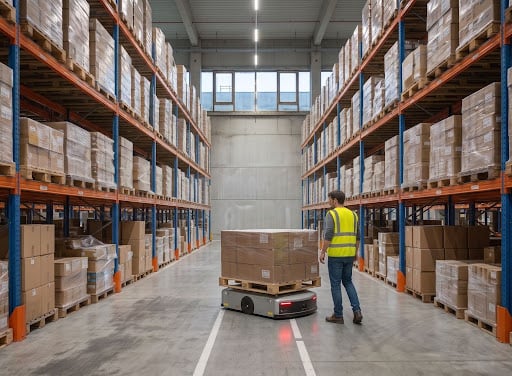
- Autonomous delivery carts in indoor environments (e.g., hospitals, warehouses);
- Educational or research platforms for autonomous navigation and AI;
- In-building mapping systems for digital twin applications;
By focusing on scalable, edge-enabled robotics, this platform bridges the gap between high-level AI and low-level embedded design, enabling exploration from algorithm design down to control loop tuning.